Media over QUIC (MoQ) Relay
Trickster relays Media over QUIC Transport (MoQT) as a caching relay. Clients subscribe to tracks through Trickster, which holds one subscription per track toward its origin and fans each object out to every subscriber. It keeps the newest groups in memory and older ones in a cache, so FETCH and late joiners are served from Trickster with only the missing objects fetched upstream. Publishers can also send tracks straight to Trickster, making it the origin.
MoQT is a live-media transport: a track is a sequence of groups (for video, typically one group per GOP), each a sequence of objects, delivered over QUIC streams or datagrams. Trickster never parses the media inside objects; it caches and forwards them as opaque payloads.
Where Trickster fits
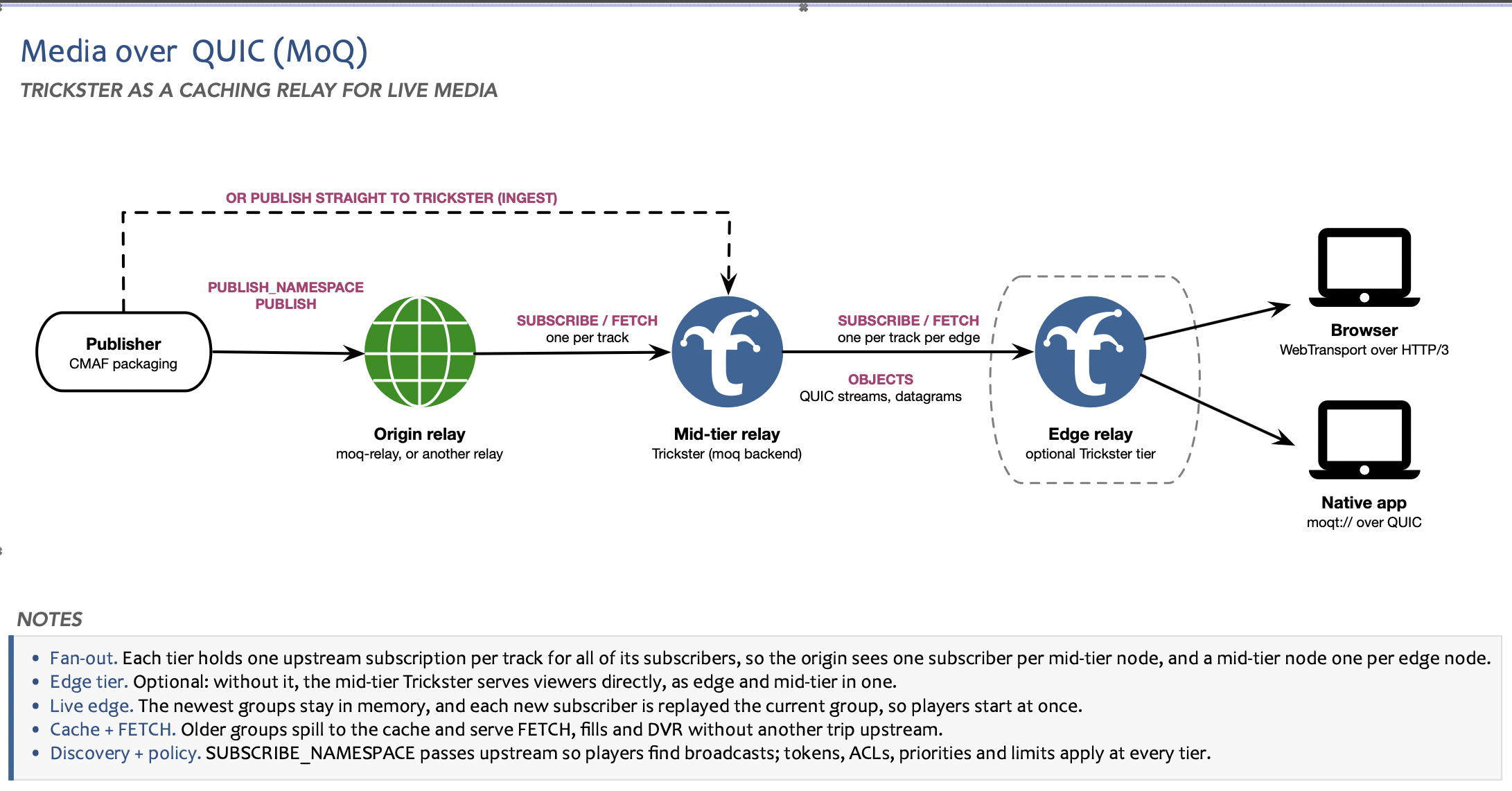
A publisher packages media into tracks and publishes them to an origin relay. A mid-tier
Trickster subscribes to the origin and serves everything below it: viewers directly, or an
optional edge tier of more Trickster nodes nearer the viewers. An edge node is a moq backend
whose origin_url names a mid-tier node’s moq listener. Each tier holds one upstream
subscription per track for all of its subscribers, with a live edge and a cache of its own, so a
tier adds capacity near the viewers while the tier above it sees one subscriber per node.
Two variations each change one part of this picture, and combine with it and with each other:
- Publishing: publishers send tracks straight to Trickster, which takes the origin relay’s place.
- Origin pools: a Trickster reaches several origins through an alb, which places each track on one of them and fails over between them.
Compatibility
MoQT is still an Internet-Draft, and implementations in the field speak different drafts. Trickster speaks drafts -17 through -22 and negotiates one per session; a session on one draft can relay a track whose origin speaks another.
| Draft | ALPN | Notes |
|---|---|---|
| -22 | moqt-22 | the newest and the preferred draft; LOCATION_FILTER carries its type |
| -21 | moqt-21 | editorial changes only |
| -20 | moqt-20 | fill fetch streams replace Joining FETCH |
| -19 | moqt-19 | range filters, MAX_REQUEST_UPDATES, multiple subscriptions per track |
| -18 | moqt-18 | moqt:// URIs, SUBSCRIBE_TRACKS, REDIRECT |
| -17 | moqt-17 | Required Request ID, PUBLISH_OK, the combined SUBSCRIBE_NAMESPACE |
Native QUIC clients negotiate the draft by ALPN, and WebTransport clients by
WT-Available-Protocols. Trickster prefers the newest draft, and offers origins every draft,
newest first. moq-dev’s relay before 0.17.3 and CLI before 0.14.3 encode -22 as -21; to work
with those releases, list -21 ahead of -22 in drafts and upstream.drafts. Drafts before -17
are not supported.
Interoperability is tested on every draft against moq-dev’s
relay (0.17.5) and moq CLI (0.14.5), including FETCH.
How clients reach the relay
- Native QUIC. A listener with
protocol: moqaccepts MoQT sessions on its UDP port. A session is routed to amoqbackend by the AUTHORITY and PATH of its SETUP, matched against the backend’shostsandpaths. - WebTransport. Browsers open WebTransport sessions on an HTTP listener that serves
HTTP/3. A
moqbackend’spathsbecome WebTransport routes there, matched like any other route by host and path. - Publishers use either path, with
PUBLISHorPUBLISH_NAMESPACE, when the backend accepts them.
All three meet in the backend’s relay, which is shared by every listener the backend is bound to.
Configuration
listeners:
  # native QUIC; TLS is part of the QUIC handshake, so there is no tls_port
  moq1:
    protocol: moq
    port: 443
  # browsers arrive by WebTransport over the default listener's HTTP/3 endpoint
  default:
    port: 8480
    tls_port: 8443
    http3:
      enabled: true

backends:
  live:
    provider: moq
    # moqt:// for a native QUIC origin, https:// for a WebTransport one; omit it to serve
    # only what publishers send
    origin_url: moqt://origin.example.com:443/live
    listener_names: [moq1, default]
    hosts: [live.example.com]
    cache_name: default
    max_ttl: 1h
    tls:
      # served to clients of both listeners
      full_chain_cert_path: /etc/trickster/tls/live.crt
      private_key_path: /etc/trickster/tls/live.key
      # trusted toward the origin
      certificate_authority_paths: [/etc/trickster/tls/origin-ca.crt]
example.full.yaml documents every option.
The moq listener
| Option | Default | Description |
|---|---|---|
port, address | the UDP port and address to bind | |
moq.handshake_timeout | 5s | the time a client has to send SETUP |
moq.idle_timeout | 2m | the QUIC idle timeout |
moq.max_sessions | 10000 | sessions served at once; past it, a new connection is closed (“session limit reached”) |
moq.max_requests_per_session | 1024 | requests a client may have open at once; past it, a request is refused with EXCESSIVE_LOAD |
moq.max_filter_ranges, moq.max_request_updates | 16, 64 | advertised to clients in SETUP |
moq.drafts | [22, 21, 20, 19, 18, 17] | accepted drafts, most preferred first |
moq.implementation | trickster/<version> | the MOQT_IMPLEMENTATION setup option |
moq.goaway_uri | the moqt:// URI a GOAWAY names when the listener stops; see Reloads and shutdown |
A moq listener needs a certificate. It takes one from the tls block of a backend it
serves, or at runtime with tls_runtime_certs: true, as the
Kubernetes controller sets. Certificate files are watched and rotated as for any
listener (tls.md).
A moq listener may share its UDP address and port with the HTTP/3 endpoint of an HTTPS
listener, or with another moq listener, as long as they serve different ALPNs. Each QUIC
connection goes to the listener whose protocol it negotiated, and each keeps its own
certificates and routes. A moq listener never shares a port with a protocol: udp
listener.
The listener’s ip_acl_name is judged on the client’s first packet, before its TLS handshake, so a
refused client costs no handshake; drop and reject both refuse it there, since QUIC cannot
leave a client unanswered. Its decisions are counted in trickster_ip_acl_decisions_total with
scope="listener". The listener’s rate_limiter_name (see Limits) is judged once the
handshake has verified the client’s address. Once the session’s SETUP routes it to a backend, it
is judged by that backend’s ip_acl_name (counted with scope="backend") and geo_acl_name, so
backends sharing a listener keep their own lists. A session one refuses closes with
UNAUTHORIZED, and is logged at debug.
A reload judges the sessions already open by the new lists: the listener’s ip_acl_name, and
the ip_acl_name and geo_acl_name of each session’s backend, over native QUIC and WebTransport
alike. A session the new lists refuse is closed with UNAUTHORIZED. A WebTransport session is
not judged again by its HTTPS listener’s lists. The listener’s path_normalization applies to
the PATH of a SETUP before it is routed, and a path it refuses closes the session with
MALFORMED_PATH. Settings that shape TCP connections and HTTP requests (connections_limit,
the request timeouts and body limits, max_header_bytes, proxy_protocol, trusted_proxies)
have no effect on a moq listener, and are warned of at load.
Every path of a moq backend reaches the same tracks, whichever path a session named, so a
path cannot carry its own ip_acl_name, geo_acl_name, authenticator_name or
rate_limiter_name: one would guard nothing a session on another path could not reach. Serve
tracks that need other lists from a backend of their own, or grant them by namespace with
tokens. A path with a handler of its own answers HTTP requests, and keeps
its lists. A backend served by a moq listener cannot name an authenticator_name either,
since a native session carries no HTTP credentials; authorize its sessions with tokens.
cors, response_headers and mirrors have no effect on a session, and a request rewriter or
request_headers reaches only a WebTransport session’s CONNECT; each is warned of at load.
The moq backend
| Option | Default | Description |
|---|---|---|
origin_url | moqt://host[:port]/path (native QUIC) or https://host[:port]/path (WebTransport); optional | |
hosts, paths | any, / | the AUTHORITY and PATH, or the WebTransport request’s host and path, the backend serves |
cache_name | default | the cache older groups spill to |
max_ttl | 25h | the most a spilled group lives, and its lifetime when its track sets no MAX_CACHE_DURATION |
negative_cache_name | default | the negative cache whose 404 TTL keeps an origin’s DOES_NOT_EXIST refusal of a track; see Caching |
tls | the certificate served to clients, and the origin’s verification | |
moq.upstream.alb | an alb of moq backends to reach the origins through, in place of origin_url; see Origin pools | |
moq.upstream.drafts | [22, 21, 20, 19, 18, 17] | drafts offered to the origin, most preferred first |
moq.upstream.prewarm | false | keeps the upstream subscription forwarding while every subscriber is paused |
moq.upstream.reconnect_backoff | 1s | the first wait before re-subscribing a lost upstream subscription |
moq.upstream.linger | 5s | how long an upstream subscription stays after its last subscriber leaves |
moq.upstream.max_gap_fetches | 16 | upstream fetches one FETCH or fill may issue |
moq.live_edge.groups | 3 | groups of each track kept in memory |
moq.live_edge.max_size_bytes | 64MiB | payload bytes the live edge holds across the backend’s tracks |
moq.spill | true | writes groups leaving the live edge, and groups fetched upstream, to cache_name |
moq.fill_timeout | 2s | the wait for upstream fetches when a FETCH or fill names no FILL_TIMEOUT |
moq.max_object_size_bytes | 64MiB | the largest object; a larger one resets its stream |
moq.webtransport.* | see WebTransport and browsers | |
moq.publish.* | see Publishing | |
moq.authorization.* | see Authorization |
A moq backend without origin_url (or upstream.alb) has no origin. It serves what
publishers send, and validation warns when it accepts no publishers either. With an origin, the
health check completes a SETUP exchange with it on a fresh session; an origin-less backend is
left unprobed.
Routing sessions
A native session names its AUTHORITY and PATH in SETUP; when it names no authority, the TLS
server name stands in, and when it names no path, /. Among the backends on the listener, one
naming the host exactly wins over one naming it by wildcard, which wins over one naming no host.
Among those, the longest segment-aligned path prefix wins. A listener with one backend serves
every session with it, and a session no backend matches is closed with INVALID_PATH. No two
backends on a listener may claim the same host and path.
WebTransport and browsers
A moq backend bound to an HTTP listener serves WebTransport sessions on that listener’s HTTP/3
endpoint (http3.md); validation warns when the listener has none. The endpoint
switches to WebTransport only while a moq backend uses the listener, and a reload that binds
or unbinds one changes how new connections are served without restarting the endpoint.
Each of the backend’s paths accepts WebTransport sessions at and below it (a regex path
matches as a pattern), and a backend with no paths accepts them at /. The usual HTTP routing
applies: on a listener shared with other backends, give the moq backend hosts or make it
is_default, or reach it under its name (https://host/<backend>/). The CONNECT request runs
through the route’s middleware, so authenticator_name, IP and geo ACLs, metrics and access logs
all apply to it.
| Option | Default | Description |
|---|---|---|
moq.webtransport.drafts | [22, 21, 20, 19, 18, 17] | drafts accepted from WebTransport clients, most preferred first |
moq.webtransport.default_draft | 0 | the draft assumed for a client that offers no WT-Available-Protocols, and for a WebTransport origin that answers without WT-Protocol; 0 refuses both |
moq.webtransport.allowed_origins | browser origins (scheme://host[:port]) that may open sessions, or *; empty allows only an origin naming the requested host, and a client that sends no Origin is always allowed | |
moq.webtransport.max_sessions | 10000 | WebTransport sessions the backend serves at once |
moq.webtransport.goaway_uri | the https:// URI a GOAWAY names when the listener stops |
Trickster answers 403 for a refused origin, 405 for a method other than CONNECT, 400 for a
CONNECT that is not WebTransport or offers no usable draft, and 503 past max_sessions.
WebTransport sessions take the moq listener defaults for their limits. Chrome 143, Firefox 155
and Safari 26.4 send WT-Available-Protocols through the WebTransport protocols option; a
browser needs a certificate it trusts.
Toward an https:// origin, backends that reach the same host and port with the same tls
settings and drafts carry their WebTransport sessions on one QUIC connection, each backend with
its own session for its own path. The connection offers WebTransport flow control, which an
origin must also enable to take several sessions on one connection. An origin that refuses a
second session is dialed one connection per session from then on. The connection closes with
its last session. Native moqt:// origins get a connection per backend, since a native
connection is a single session.
Caching
Each track’s newest live_edge.groups groups stay in memory, within a backend-wide
live_edge.max_size_bytes budget that evicts the oldest groups first. Objects are stored once
and forwarded cut-through as their bytes arrive, so every subscriber and the cache share one
copy. A group leaving the live edge spills to cache_name as one entry, by reference in a
memory cache. Its key includes the backend’s name, so backends sharing a cache never read or
overwrite each other’s groups, even for tracks of the same name. It lives for the track’s
MAX_CACHE_DURATION less the oldest object’s age, capped by max_ttl. An object past its MAX_CACHE_DURATION is unknown again in both tiers and
is not forwarded. Spilled groups are indexed in memory, so after a restart a persistent cache’s
groups are fetched from the origin again rather than found. A track found malformed (a duplicate
object differing from the first copy, or an object past the end of its group or track) is
dropped uncached and its subscribers end with MALFORMED_TRACK.
An origin’s DOES_NOT_EXIST refusal of a track is MoQ’s 404. It is kept for the 404 TTL of
the backend’s negative_cache_name, and answers SUBSCRIBE, FETCH and TRACK_STATUS for the track
without asking the origin again. The default negative cache is empty, so nothing is kept unless
configured:
negative_caches:
  default:
    '404': 3s
Only the origin’s refusal is kept. A namespace publisher’s is not, and neither are codes that
depend on the requester or pass on their own (UNAUTHORIZED, the token codes, TIMEOUT,
INTERNAL_ERROR, EXCESSIVE_LOAD). A PUBLISH of the track, or a namespace arriving that covers
it, forgets the refusal at once, so a stream that starts after its viewers ask is served as soon
as it is published or announced. A backend keeps at most 4096 refusals. Clients that keep asking
for names that do not exist are a matter for rate limiting.
FETCH and fills (-20 and later) are served from the live edge and the cache where a group is
known in full. Each run of groups between them is fetched upstream with one request, in the
requested group order, and cached for the next request. Past max_gap_fetches requests, the
remaining gaps are reported as an End of Unknown Range. A group is
known in full only when every object in the requested range is present or known absent. A
publisher that never signals the end of its groups therefore has past groups fetched upstream
rather than answered incompletely. FILL_TIMEOUT (default fill_timeout, at most 30 seconds)
bounds the upstream wait. Past it, the rest of the range is reported as an End of Timed-Out
Range, and an unreachable origin as an End of Unknown Range. A FETCH that names no group order
is served ascending, as the drafts require, whatever the track’s publisher prefers. Joining
FETCH, on drafts through -19, is served the same way.
Subscriptions
One upstream subscription per track carries every downstream subscription to it, each filtered
at the relay by its own location window and range filters. A new subscription first gets the
newest group the relay holds, from the start of its window, and then what arrives. A player
joining at the current group, as moq-dev’s does with a Relative Start of 1, so gets a catalog
that was published once, and a subscription starting at the Next Object gets only what arrives.
Older groups come by fill or FETCH. Draft -22 §3.5 has a joiner ask for the current group with
a fill; the relay delivers it either way. SUBSCRIBE_OK waits until the upstream
subscription is established. Forwarding follows the subscribers: the upstream subscription
forwards while any subscriber does, and pauses otherwise unless upstream.prewarm keeps it
forwarding. A lost upstream subscription is re-subscribed with doubling backoff, up to five
attempts, while the downstream subscriptions stay open. That includes one the origin ends with
UPDATE_FAILED for refusing the relay’s own update, such as a resume or an EXPIRES renewal;
should the retries fail, its subscribers see INTERNAL_ERROR, since the update was never theirs. Only when that fails do they end with
PUBLISH_DONE. An upstream subscription lingers for upstream.linger after its last subscriber
leaves, so a returning viewer finds it warm.
When the upstream gives an EXPIRES, the relay asks to extend the subscription before it
elapses, with an empty REQUEST_UPDATE at three quarters of the time given. A new EXPIRES in
the answer schedules the next renewal; an answer without one, such as to a FORWARD change,
leaves the pending renewal as it was. The relay never ends a downstream subscription on a
timer, so it sends no EXPIRES downstream.
NEW_GROUP_REQUEST reaches the publisher as the spec requires of relays:
- with the upstream
SUBSCRIBEwhile the track has no established subscription; - afterwards, as a
REQUEST_UPDATEto every source, but only for a value of 0 or one past the Largest Group, on a track whoseDYNAMIC_GROUPSis 1, and only while no request at least as large is outstanding. A request is outstanding until the Largest Group increases.
Publishing
With moq.publish.enabled, a backend accepts PUBLISH and PUBLISH_NAMESPACE and becomes the
origin of what publishers send. Open ingest belongs behind a network boundary or
authorization.
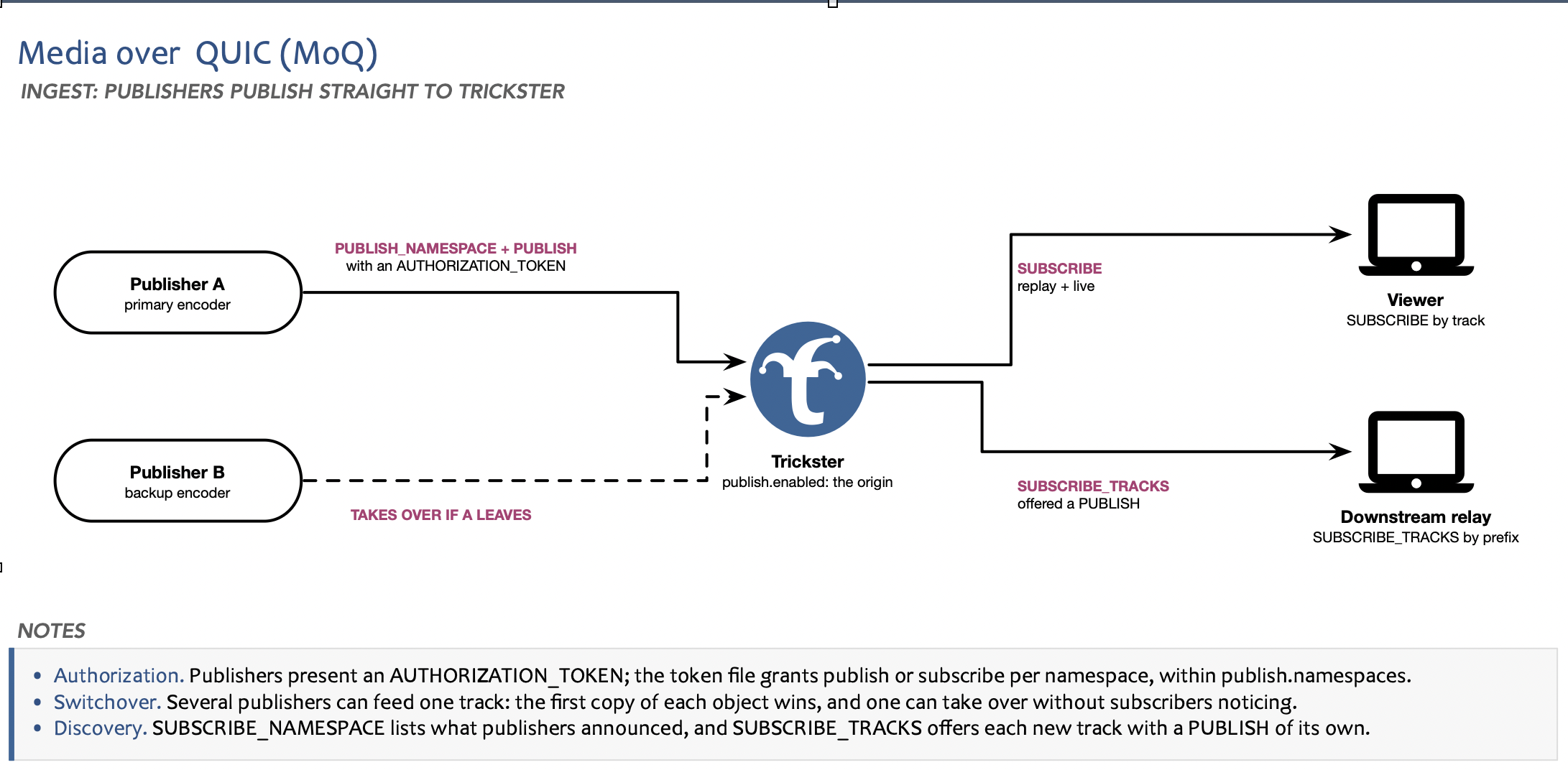
Here Trickster takes the origin relay’s place in Where Trickster fits. Its subscribers, and any tiers below it, are served as they would be from a pulled track.
| Option | Default | Description |
|---|---|---|
moq.publish.enabled | false | accepts publishers |
moq.publish.namespaces | any | namespace prefixes publishers may claim, as fields joined by / (live/studio) |
moq.publish.max_publishers_per_track | 4 | publishers of one track at once; 0 allows any number |
A track can have several sources at once: publishers’ PUBLISHes, and the subscriptions the
relay opens toward every session that published a matching namespace, or toward the origin when
none did. The first copy of each object wins, an identical duplicate is dropped, and a differing
one makes the track malformed. A publisher can take over from another without its subscribers
noticing, and one whose session drops can return on a new session before the relay gives up on
the track. The relay never pauses a publisher, so an ingest backend’s cache keeps everything
published.
SUBSCRIBE_NAMESPACE is answered with the namespaces publishers announced, and kept current as
they come and go. A backend with an origin also learns the origin’s namespaces, in either of two
ways, and announces a namespace once however many sources report it:
- It forwards the request to the origin. What an origin reports is backend-wide, so every scope
shares the upstream requests, and their prefixes never overlap, as one session requires: a
prefix that an upstream request covers shares it, and a wider one replaces the narrower
requests it covers. A replaced request’s namespaces stay announced while the wider one
reports them again, so subscribers see no flap. A lost request withdraws what it reported and
is sent again. One the origin refuses is not retried, except a
PREFIX_OVERLAPrefusal, which the replacement can race. One whose last subscriber leaves lingers forupstream.linger. - It accepts
PUBLISH_NAMESPACEfrom the origin on its upstream session, as moq-dev’s relay sends, and reports those namespaces until the origin withdraws them or the session ends.
SUBSCRIBE_TRACKS offers each published track under the prefix with a relay PUBLISH. A
backend with an origin forwards it the same way, shared by prefix (as SUBSCRIBE_NAMESPACE with
the PUBLISH option on draft -17). Each PUBLISH the origin sends in answer becomes a source of
its track and is offered to every matching subscriber, in every scope. A subscriber in another
scope is served the track pulled from the origin with SUBSCRIBE. An origin PUBLISH that no
subscription covers is refused with UNINTERESTED.
A SUBSCRIBE naming a RENDEZVOUS_TIMEOUT waits up to that long (at most 30
seconds) for a publisher to arrive; without one, a track nobody publishes is refused with
DOES_NOT_EXIST. Publishers are refused with:
NOT_SUPPORTEDwhen the backend takes no publishers;UNAUTHORIZEDoutsidepublish.namespaces, or without a granted token;EXCESSIVE_LOADpastmax_publishers_per_track.
Authorization
moq.authorization.mode is none (the default) or token. In token mode, every request needs
an AUTHORIZATION_TOKEN that token_file grants, sent in the request or in the session’s SETUP.
# <token> <publish|subscribe|any> [namespace]
studio-encoder publish live/studio
viewer-7f3a subscribe live
ops-tools any
SUBSCRIBE, FETCH, TRACK_STATUS, SUBSCRIBE_NAMESPACE and SUBSCRIBE_TRACKS need a
subscribe grant, and PUBLISH and PUBLISH_NAMESPACE a publish grant. A grant’s namespace
must prefix the request’s, so a grant for live covers live/studio but not vod. A grant with
no namespace covers every namespace. The file is read again when it changes, checked at most
once a second; a file that no longer parses keeps its last grants, and one that cannot be read
at load fails the backend. A WebTransport CONNECT is also subject to the route’s
authenticator_name, before any MoQT request is made. A native session carries no HTTP
credentials, so a backend that a moq listener serves cannot name an authenticator, and tokens
are how its sessions are authorized.
Origin pools
moq.upstream.alb names an alb whose pool members are moq backends with origins.
The routed backend keeps its relay, cache, live edge, WebTransport, publishing and authorization,
and reaches its origins through the alb, which picks one member per track:
backends:
  live:
    provider: moq
    listener_names: [moq1]
    moq:
      upstream:
        alb: origins
  origins:
    provider: alb
    alb:
      mechanism: hrw
      pool: [origin-a, origin-b]
  origin-a:
    provider: moq
    origin_url: moqt://origin-a.example.com/
  origin-b:
    provider: moq
    origin_url: moqt://origin-b.example.com/
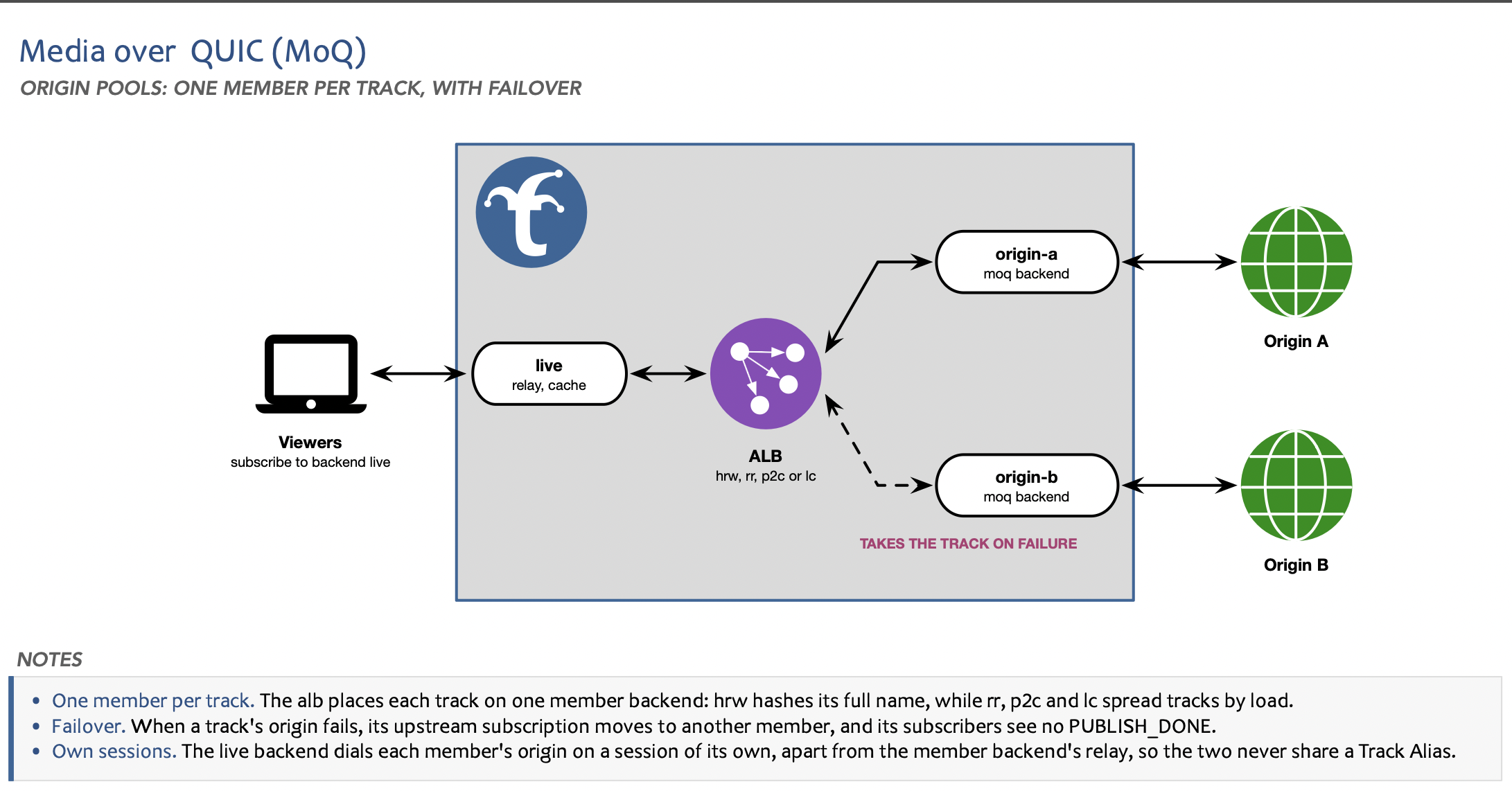
The diagram shows this configuration, all in one Trickster process: viewers subscribe to live,
whose relay reaches Origin A and Origin B through the origins alb. In
Where Trickster fits, it replaces the mid-tier’s single origin.
The mechanism must pick a single member: rr, p2c, hrw (each track placed by its full name)
or lc. When a track’s origin fails, its upstream subscription moves to another member and its
subscribers see no PUBLISH_DONE. A member that fails its health check is passed over until it
recovers, and stream.passive_health on the alb ejects members whose origins cannot be dialed.
Pool members must be moq backends with origins; nested albs and discovery are refused.
The routed backend dials each member on a session of its own, apart from the member backend’s
own relay, so the two never share a Track Alias. A SUBSCRIBE_NAMESPACE or SUBSCRIBE_TRACKS
it forwards goes to the member the prefix places, and what that member’s origin publishes on the
session reaches the routed backend’s subscribers.
A member listed on an HTTP listener is reachable there at /<member name>/, as any backend is,
and judged by its own lists rather than the routed backend’s; give members
path_routing_disabled: true so only the routed backend serves sessions. The Kubernetes
controller does so for the members it generates.
Priorities
MoQT orders objects by subscriber priority, then publisher priority, then group order (each 0 to 255, lower first). QUIC offers eight stream urgencies (RFC 9218), so Trickster maps the two priorities onto urgencies 1 to 6:
| Subscriber priority | Publisher priority below 128 | Publisher priority 128 and above |
|---|---|---|
| 0–63 | 1 | 2 |
| 64–191 | 3 | 4 |
| 192–255 | 5 | 6 |
Control and request streams take urgency 0. Within an urgency, an ascending subscription’s streams are sent oldest first, while a descending subscription’s streams share bandwidth so its newest group keeps moving. Datagrams have no priority, and WebTransport streams take none either, since webtransport-go exposes no stream urgency.
Reloads and shutdown
A reload never ends a session. A session keeps the backend it was routed to for its life,
even when a reload removes that backend; only new sessions see the new configuration. Each
backend’s relay (its live edge, upstream subscriptions and upstream session) carries over to the
reloaded backend while its relay settings are unchanged. A reload that changes them starts a
new relay for new sessions, and the old one serves its sessions to their end. Publishing and
authorization policy takes effect when a reload commits. A reload restarts a moq listener only
when its address, port or moq block changes; its sessions are then drained as at shutdown.
When Trickster stops, each session gets a GOAWAY naming the listener’s goaway_uri (or the
backend’s webtransport.goaway_uri), with the drain’s remaining time as its timeout. New
requests on a departing session are answered with REDIRECT to that URI on drafts that have it
(-18 and later), or refused with GOING_AWAY. Sessions still open when the drain ends are closed
with GOAWAY_TIMEOUT.
Limits
| Limit | Value |
|---|---|
| sessions per listener | moq.max_sessions (10000) |
| open requests per session | moq.max_requests_per_session (1024), then EXCESSIVE_LOAD with a 1-second retry |
| WebTransport sessions per backend | moq.webtransport.max_sessions (10000) |
| object size | moq.max_object_size_bytes (64 MiB) |
| live edge | moq.live_edge.max_size_bytes (64 MiB) per backend |
| upstream fetches per FETCH or fill | moq.upstream.max_gap_fetches (16) |
| upstream wait for a FETCH or fill | FILL_TIMEOUT, at most 30 seconds |
| rendezvous wait | RENDEZVOUS_TIMEOUT, at most 30 seconds |
| data streams waiting for an unknown track alias | 64 per session, each for at most 2 seconds |
| namespaces | 32 fields and 4096 bytes |
remembered DOES_NOT_EXIST refusals | 4096 per backend |
Rate limiters keyed on client_ip, or on no key for one bucket, limit
clients by address:
- A
moqlistener’srate_limiter_namecounts its sessions (unitsessions), each judged when its connection arrives, after the listener’sip_acl_name. A session over the limit is closed before it begins. - A
moqbackend’srate_limiter_namecounts theSUBSCRIBE,FETCHandTRACK_STATUSrequests of its sessions (unitrequests), native and WebTransport alike, so a client’s sessions share one budget. A request over the limit is refused withEXCESSIVE_LOAD, and a Retry Interval of the wait until it could pass. - WebTransport sessions also pass the HTTPS listener’s limiter, and the backend’s counts each CONNECT as a request too.
rate_limiters:
  moq-sessions:
    keys: [client_ip]
    limit: 20
    window: 1m
  moq-requests:
    keys: [client_ip]
    limit: 600
    window: 1m
listeners:
  moq1:
    protocol: moq
    port: 443
    rate_limiter_name: moq-sessions
backends:
  live:
    provider: moq
    rate_limiter_name: moq-requests
Only client_ip is a key a MoQ limiter can read, and close is not an action it takes. Their
decisions are counted in trickster_ratelimit_decisions_total with plane="moq".
Metrics and logs
| Metric | Labels |
|---|---|
trickster_moq_sessions_total | listener_name, backend_name, role, transport (quic, webtransport), draft, result (ok, refused, no_route, busy, failed) |
trickster_moq_active_sessions | listener_name, backend_name, role |
trickster_moq_requests_total | backend_name, type, result |
trickster_moq_active_subscriptions | backend_name, direction (upstream, downstream) |
trickster_moq_objects_total | backend_name, direction (in, out), delivery (stream, datagram, fetch) |
trickster_moq_bytes_total | backend_name, direction |
trickster_moq_dropped_objects_total | backend_name, reason (oversize, delivery_timeout, datagram_queue_full, spill_queue_full) |
trickster_moq_fetch_objects_total | backend_name, source (live_edge, cache, upstream) |
trickster_moq_live_edge_bytes | backend_name |
trickster_moq_publishers_active | backend_name |
trickster_moq_errors_total | backend_name, class |
Track and namespace names are never labels. Spilled groups count in the cache’s own
trickster_cache_* metrics. Each session’s close is logged at info with its listener, backend,
draft, transport, client, duration and reason.
A native session writes one line to its backend’s access_log when it ends, as a request does,
with the method SETUP, the session’s PATH as the path, its AUTHORITY as the host, the
negotiated ALPN (such as moqt-22) as the protocol, and the session’s duration; it has no
status, which is logged as 0. With the backend’s tracing_name, each native session is one
moq session span carrying moq.backend, moq.authority, moq.path and client.address, and
moq.end with why it ended. A WebTransport session is logged and traced as its CONNECT request,
and since a CONNECT lasts as long as its session, it is counted in
trickster_frontend_requests_total but not timed in trickster_frontend_requests_duration_seconds.
A moq backend’s health is served at /trickster/health/<backend name> on the metrics listener,
as the result of its origin probe. Purging by path does not apply to a moq backend, whose cache
entries are groups of tracks rather than responses to paths, and is refused; spilled groups
expire by max_ttl.
Kubernetes
The Kubernetes controller serves MoQT through a Gateway listener with the protocol
trickstercache.org/moq and UDPRoutes, and WebTransport through an HTTPRoute whose
TricksterCachePolicy names provider: moq. See
kubernetes-gateway.md.
Trying it locally
One command runs a harness: moq-dev’s relay as the origin, hack/diagstreamer publishing a live
test pattern into it, and Trickster in the foreground with
docs/developer/environment/trickster-config/moq.yaml. A second opens a player page, which
Trickster serves at https://localhost:8583/player/, in a Chrome profile that trusts the
development certificate. The page lists the broadcasts the relay announces and plays the selected
one with moq-dev’s <moq-watch> element, loaded from a CDN:
make developer-moq
make developer-moq-browser
ARGS passes flags to Trickster, as in make developer-moq ARGS="-log-level debug". The
harness’s Trickster listens on ports 8580 to 8590, clear of make serve-dev’s, so the two can
run side by side. The integration stack’s relay publishes the same UDP port as the harness’s, so
stop it first if it is running.
The developer environment’s moq profile runs moq-dev’s relay on UDP 10443, which serves as an
origin, and make dev-certs writes a self-signed certificate for localhost:
make dev-certs
make developer-start-moq
Point a relay at it, with a native listener on UDP 8490 and WebTransport on the default listener’s HTTP/3 endpoint:
listeners:
  moq1:
    protocol: moq
    port: 8490
  default:
    tls_port: 8483
    http3:
      enabled: true
backends:
  demo:
    provider: moq
    origin_url: moqt://127.0.0.1:10443/
    listener_names: [moq1, default]
    tls:
      full_chain_cert_path: docs/developer/environment/certs/trickster-dev.crt
      private_key_path: docs/developer/environment/certs/trickster-dev.key
      # the dev relay generates its own certificate
      insecure_skip_verify: true
hack/moq-client subscribes, publishes and fetches over native QUIC or WebTransport. It
publishes synthetic groups of random bytes behind a small header, which a subscriber checks
byte for byte:
# publish a group every second into the dev relay
go run ./hack/moq-client -url moqt://127.0.0.1:10443/ -insecure -pub demo/video

# subscribe through Trickster's moq listener, and by WebTransport under the backend's name
go run ./hack/moq-client -url moqt://localhost:8490/ -ca docs/developer/environment/certs/trickster-dev.crt -sub demo/video
go run ./hack/moq-client -url https://localhost:8483/demo/ -ca docs/developer/environment/certs/trickster-dev.crt -sub demo/video

# fetch groups behind the live edge, by the IDs the subscriber printed
go run ./hack/moq-client -url moqt://localhost:8490/ -ca docs/developer/environment/certs/trickster-dev.crt -fetch demo/video -from 1791148101 -to 1791148103
A published group’s ID is the Unix time it started, so a restarted publisher never reuses a
group a relay has cached. -draft offers a single draft, -token sends an
AUTHORIZATION_TOKEN, -groups stops after that many groups, and -h lists the rest. Each
received object prints verified, unverified (a payload without the synthetic header), or
CORRUPT, and the client exits nonzero when any object fails verification.
For real media, publish a fragmented MP4 with moq-dev’s CLI into the dev relay, or into a
backend that accepts publishers, and play it in moq-dev’s web player through Trickster’s
WebTransport endpoint with a certificate the browser trusts.
hack/diagstreamer generates a live feed with a clock and a
timing strip in the picture, as an ABR ladder of CMAF tracks with MSF and hang catalogs, and
publishes it itself:
go -C hack/diagstreamer run ./cmd/diagstreamer -out moq -moq-url moqt://localhost:8490/ -moq-insecure
moq --connect moqt://localhost:8490/ --broadcast diagstreamer.msf export --catalog-format hang fmp4 > out.mp4
Troubleshooting
- A session closes with
INVALID_PATH: no backend on the listener matches the session’s AUTHORITY and PATH. Checkhostsandpaths, or bind one backend to the listener. - WebTransport answers
404: the CONNECT matched no route. Give the backendhosts, make itis_default, or use the backend’s name as the path prefix. - WebTransport answers
400: the browser offered no draft the backend accepts. Checkmoq.webtransport.drafts, or setdefault_draftfor a client that offers none. - A subscription is refused with
DOES_NOT_EXIST: the origin does not have the track, or an origin-less backend has no publisher for it. - Objects stop and resume: compare
trickster_moq_dropped_objects_totalby reason, andtrickster_moq_active_subscriptions{direction="upstream"}for upstream losses. - FETCH reaches the origin every time: the groups never spilled (
moq.spill: false, or a cache that refused them, counted intrickster_moq_errors_total{class="cache"}), or the publisher never marks the end of a group.
Known gaps
- No TCP fallback: WebTransport over HTTP/2 is not served, so clients need UDP.
- No packaging: Trickster does not convert between MoQT and HLS, DASH or other formats.
- Upstream subscriptions are never filtered, so
MAX_FILTER_RANGESis not used toward origins. - On a draft -17 origin,
SUBSCRIBE_NAMESPACEasks for namespaces and for PUBLISHes alike, so a forwarded namespace request and a forwarded track request with overlapping prefixes conflict. The second is refused withPREFIX_OVERLAP, and given up after the retries. - moq-dev’s relay cannot be a WebTransport origin, because it does not support the
reset_stream_atextension that WebTransport over HTTP/3 needs. - Stream priorities and reliable reset boundaries are not available over WebTransport (see Priorities).